Duncan Lyster
Duncan Lyster

DPhil Candidate, Planetary Physics

About Me

I’m a planetary scientist in the final year of a DPhil in Atmospheric, Oceanic and Planetary Physics at the University of Oxford, supervised by Dr Carly Howett. I specialise in thermal-infrared remote sensing: using temperature measurements from spacecraft to work out what planetary surfaces are made of and what might be happening beneath them.

I lead development of TEMPEST, an open-source thermophysical model, and I’m a member of the Surface Composition Working Group for NASA’s Lucy mission. Alongside modelling, I work on infrared imaging and thermal mapping instruments, from filter design for Oxford’s Enceladus Thermal Mapper to preparing for Europa Clipper, JUICE and a future ESA mission to Enceladus.

Before Oxford I worked as an acoustics consultant and as a technical officer at UNSW Sydney, and founded a surfboard company. I’m now looking for postdoctoral positions in planetary science, and I’m open to consulting work on infrared imaging, thermal mapping and instrument design.

Download CV
Interests
  • Thermal-Infrared Imaging & Mapping
  • Thermophysical Modelling
  • Remote-Sensing Instrument Design
  • Icy Moons & Ocean Worlds
  • Asteroids & NASA’s Lucy Mission
Education
  • DPhil Atmospheric, Oceanic & Planetary Physics

    University of Oxford

  • MPhys Physics (First Class)

    University of Exeter (exchange year at University of Wollongong, Australia)

Research

I build and apply thermal models that turn spacecraft measurements into physical understanding of planetary surfaces, from binary asteroids to the icy shells of ocean worlds.

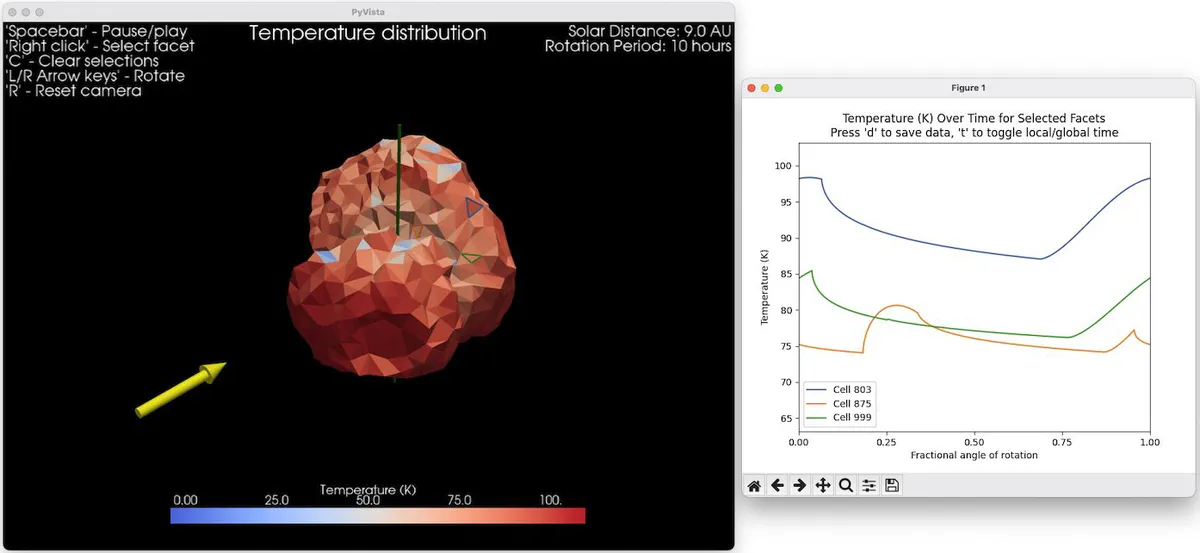
TEMPEST visualisation of modelled surface temperatures on an irregularly shaped asteroid, with temperature curves for selected facets
Open-source software

TEMPEST thermophysical model

TEMPEST is a modular Python model that predicts surface temperatures on airless bodies of any shape. Unlike classic 1D periodic solvers, it handles eclipses, tumbling rotation, seasonal change and flyby geometries, and it underpins nearly all of my research.
  • Surface roughness, multiple heat-conduction schemes and modular scattering
  • Validated against the established Spencer 1D thermal model
  • Applied to Lucy, Europa, Enceladus, Lunar Trailblazer and the PRIME mission concept
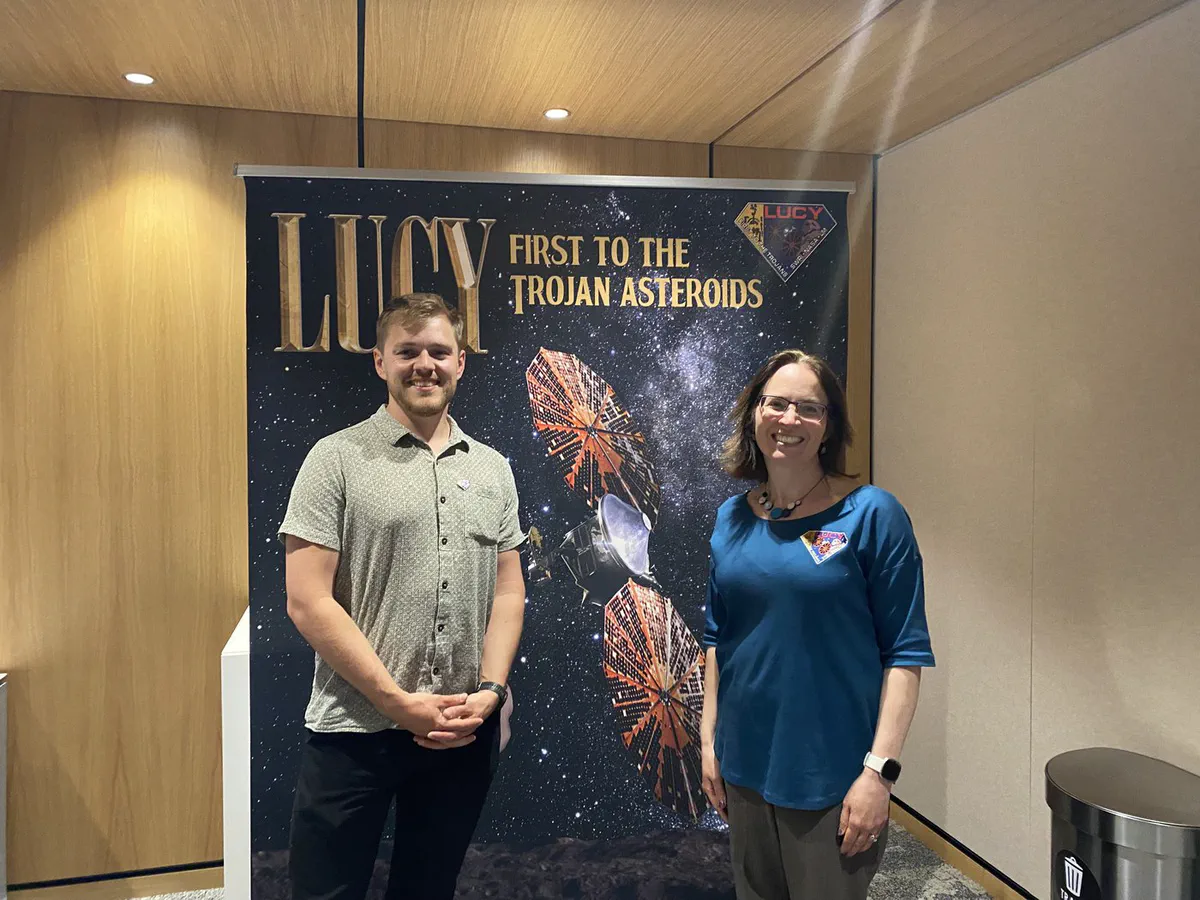
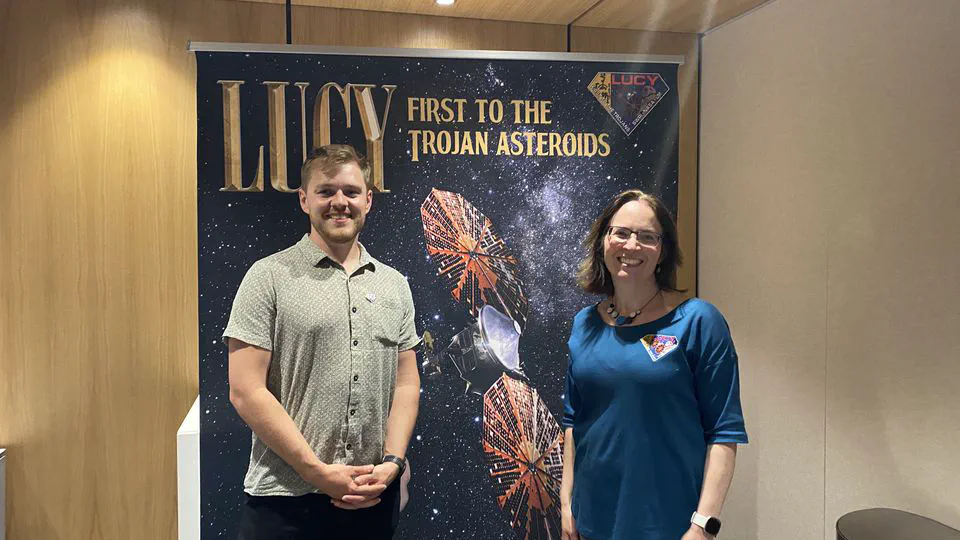
Duncan Lyster and Carly Howett in front of a Lucy mission banner in Boulder, Colorado With Carly Howett at the Donaldjohanson encounter, Boulder, 2025
NASA Lucy mission

Binary asteroids and the Trojan tour

Lucy is the first mission to the Jupiter Trojan asteroids, remnants of the early Solar System. As a member of the mission’s Surface Composition Working Group, I model what its L’TES thermal instrument sees during flybys. Using the 2023 encounter with the binary asteroid Dinkinesh and its moon Selam, I’ve been working out how an unresolved companion affects thermal inertia estimates, with direct implications for the binary Trojans still to come.
  • Thermal modelling of the Dinkinesh flyby
  • Early temperature estimates for asteroid Donaldjohanson (2025)
  • Contributed to thermophysical work on Trojan (11351) Leucus
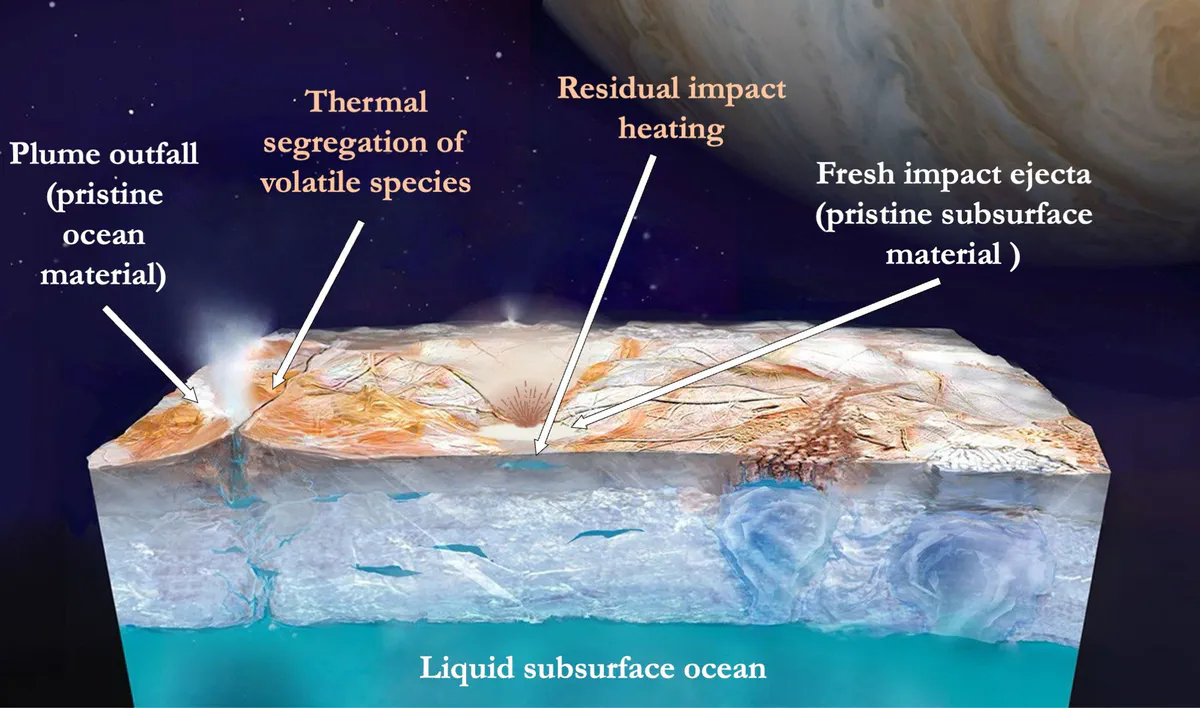
Cutaway diagram of Europa's ice shell showing plume outfall, thermal segregation, residual impact heating and fresh impact ejecta
Ocean worlds

Finding activity on Europa

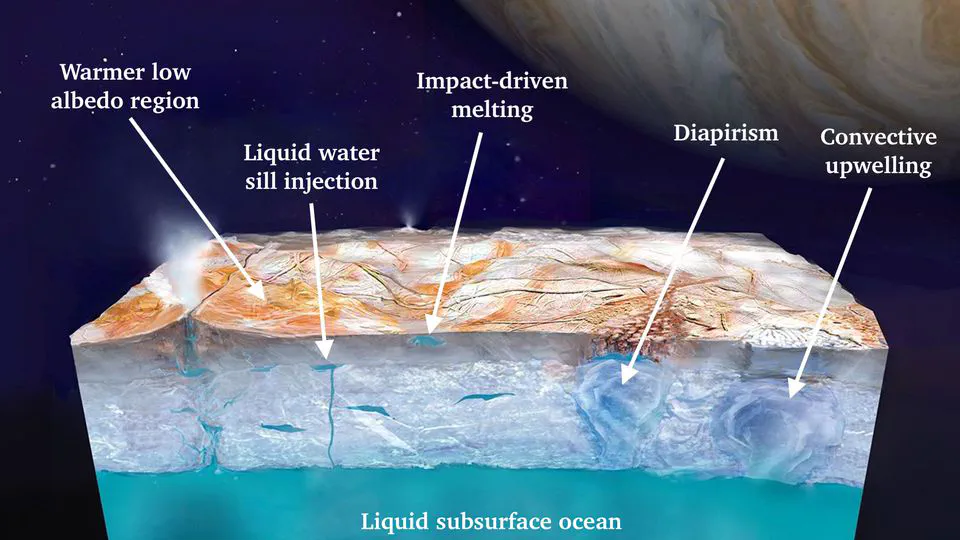
Europa Clipper and ESA’s JUICE reach Jupiter in the early 2030s. A key question for both is whether a warm spot on Europa’s surface means near-surface activity, such as liquid water moving through the ice, or simply a patch of darker or finer-grained material. I combine TEMPEST with albedo maps and high-resolution terrain models to work out which signatures of activity would actually be detectable, and how to tell them apart.
  • Detectability of low-flux endogenic heat on Europa (Best Oral Presentation, BPSC 2026)
  • Thermal inertia and albedo mapping from Galileo PPR data (Howes et al. 2026, MNRAS)
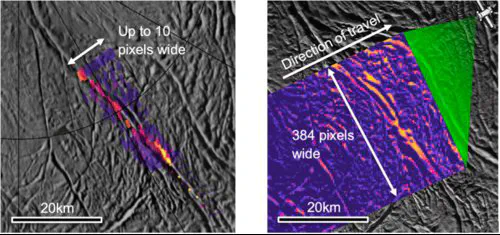
Simulated thermal mapping swaths across Enceladus' tiger stripe fractures
Instruments & missions

Thermal mapping of Enceladus

Enceladus vents its subsurface ocean into space through the ’tiger stripe’ fractures at its south pole. I helped design the infrared filters for Oxford’s Enceladus Thermal Mapper (ETM), a concept instrument built to measure day, night and polar-night temperatures as low as 45 K, and I’m now looking at how thermal-infrared measurements could best serve ESA’s planned L4 mission to Enceladus.
  • Filter optimisation for ETM (EGU 2024, IAC 2024)
  • Lightcurve modelling for the recovery attempt of NASA’s Lunar Trailblazer (Ehlmann et al. 2026)
  • Co-convenor, Ocean Worlds of the Solar System session, EPSC 2026

Publications

Journal articles

(2026). Dynamical and Thermophysical Properties of Asteroid (11351) Leucus: Implications for a Possible Past Satellite. The Planetary Science Journal (accepted).
(2026). Thermal Inertia and Bolometric Bond Albedo Measurements of Europa's Surface using Galileo PPR. Monthly Notices of the Royal Astronomical Society, stag1507.
(2020). Mineral dust increases the habitability of terrestrial planets but confounds biomarker detection. Nature Communications, 11, 2731.

Conference presentations, proceedings & other outputs

(2026). Disentangling Binary Thermal Inertias via L'TES Unresolved Radiometry: Implications for the Lucy Trojan Tour. Asteroids, Comets, Meteors 2026, Poznań, Poland (oral).
(2026). Thermophysical Modelling Using Albedo Mapping and DEMs Improves Interpretation of Thermal Signatures of Icy Moons. The exploration of Jupiter and its moons by ESA’s JUICE mission, ESA Winter School, Les Houches, France (poster).
(2025). Thermal Modelling of the Flyby of Binary Main Belt Asteroid (152830) Dinkinesh by NASA's Lucy Mission. EPSC–DPS Joint Meeting 2025, Helsinki, Finland (oral).
(2025). Developing Oxford's Enceladus Thermal Mapper (ETM). EPSC–DPS Joint Meeting 2025, Helsinki, Finland (poster).
(2025). TEMPEST: A Modular Thermophysical Model for Airless Bodies with Support for Surface Roughness and Non-Periodic Heating. EPSC–DPS Joint Meeting 2025, Helsinki, Finland (oral).
(2025). The PRIME Mission (Protoplanetary Remnant Investigation and Mapping of Eccentric Bodies): The Scientific Case to Visit Asteroid (34698) 2001 OD22. White paper, Thematic Area: The Solar System and Planetary Environments.
(2024). Tailoring Infrared Filters for Global Mapping of Enceladus' Surface Temperatures. Proceedings of the 75th International Astronautical Congress, Milan, Italy (oral).
(2024). Detection and Tracking of Space Debris in Cislunar Environment - A Phase 0 Mission Design. Proceedings of the 75th International Astronautical Congress, Milan, Italy.
(2024). Predicting Surface Temperatures on Airless Bodies: An Open-Source Python Tool. Europlanet Science Congress 2024, Berlin, Germany (oral).
(2024). Optimising Thermal Mapping Instrument Filters to Unveil Enceladus' Subsurface Secrets. EGU General Assembly 2024, Vienna, Austria (oral).
(2021). Water sports board with internal skeleton structure. World Intellectual Property Organization, WO2021019201A1.

Talks, Service & Awards

Selected talks

  • 2026Trojans and Greeks: The Jovian Odyssey of NASA’s Lucy Mission. Asteroid Day, University of Liverpool (keynote)
  • 2026Thermophysical Modelling of Europa’s Surface: Detectability of Habitability Indicators. BPSC 2026 (best oral presentation)
  • 2026What an Asteroid Can Tell Us About an Ocean World: Lessons from Dinkinesh for Europa. UNSW Sydney (invited, video)
  • 2025Thermal Modelling of an Asteroid Flyby by NASA’s Lucy Mission. University of Belgrade (invited)
  • 2025Finding a Lost Spacecraft: Lunar Trailblazer Lightcurve Modelling. Caltech (invited)
  • 2025Early Temperature Estimates for Asteroid Donaldjohanson. Lucy Science Working Group, SwRI Boulder
  • 2025Flyby of a Binary Main Belt Asteroid by NASA’s Lucy Mission. Oxford Physics Away Day (invited)

Service & outreach

  • 2026Co-convenor, Ocean Worlds of the Solar System, Europlanet Science Congress
  • 2026BBC Hereford & Worcester interview on the Artemis II mission
  • 2025BBC News interview on the Lucy mission
  • 2025–President, St Edmund Hall Middle Common Room, representing 400+ postgraduates on Governing Body
  • 2025–Captain (1st team), Oxford University Salsa Society; President 2024–25
  • 2024School and museum outreach, including Cherwell School, the History of Science Museum and Ysgol Dyffryn Taf
  • 2023–24Local organising committee lead, UK Planetary Forum Early Career Meeting; founding Vice President, AOPP Society
  • 2023–Fellow, Royal Astronomical Society

Awards

  • 2026Best Oral Presentation, British Planetary Science Conference
  • 2025Tony Doyle Graduate Science Prize, St Edmund Hall
  • 2025Graham Hamilton Travel Award, St Edmund Hall
  • 2024William R Miller Scholarship, St Edmund Hall
  • 2023Sidney Perry Foundation Award
  • 2022Dean’s Education Excellence Award, UNSW
  • 2019Engineers in Business Silver Award, Royal Academy of Engineering

Experience

  1. Teaching & Demonstrating

    University of Oxford and University of New South Wales
    Graduate Teaching Assistant at St Edmund Hall, Oxford (2025); Laboratory Demonstrator, Department of Physics, Oxford (2024); Teaching Assistant and Marker for Introduction to Astronomy, UNSW (2023–2025).
  2. Technical Officer

    Department of Physics, University of New South Wales, Australia
    Ran teaching labs and lecture demonstrations, supported curriculum development and led public engagement including school tours and planetarium shows. Used CAD and metalwork to build and maintain laboratory equipment, and helped develop a large-format digital writing display adopted across the department. Received the Dean’s Education Excellence Award.
  3. Acoustics Consultant

    SLR Consulting, Australia
  4. Founder

    Lyster Surfcraft Ltd, Exeter & Bristol
    Developed a water sports board with an internal skeleton structure (patent WO2021019201A1).

Education

  1. DPhil Atmospheric, Oceanic & Planetary Physics

    University of Oxford
    Thermal Remote Sensing of Small Bodies and Icy Moons: Modelling and Instrumentation for Asteroids, Enceladus and Europa. Supervised by Dr Carly Howett. Developed TEMPEST, an open-source thermophysical model, and applied it to NASA Lucy flyby data, Europa’s surface and instrument design for Oxford’s Enceladus Thermal Mapper. Thesis submission autumn 2026.
  2. MPhys Physics (First Class)

    University of Exeter (exchange year at University of Wollongong, Australia)
    Master’s project on mineral dust in terrestrial exoplanet atmospheres, using global climate simulations on the UK Met Office supercomputer; the work was later published in Nature Communications. Supervised by Prof. Nathan Mayne, Prof. F. Hugo Lambert and Dr Ian Boutle.

Get in touch

I’m always happy to talk about thermophysical modelling, missions to icy moons, collaborations, postdoctoral opportunities or consulting on infrared imaging and thermal mapping. Send me a message here or email me directly.

Email
duncan.lyster@physics.ox.ac.uk
Address
Atmospheric, Oceanic and Planetary Physics
Department of Physics, University of Oxford